Will Permanent Lights Survive an Alberta Winter? Chinooks, −40° Cold, Hail and Freeze-Thaw, Explained
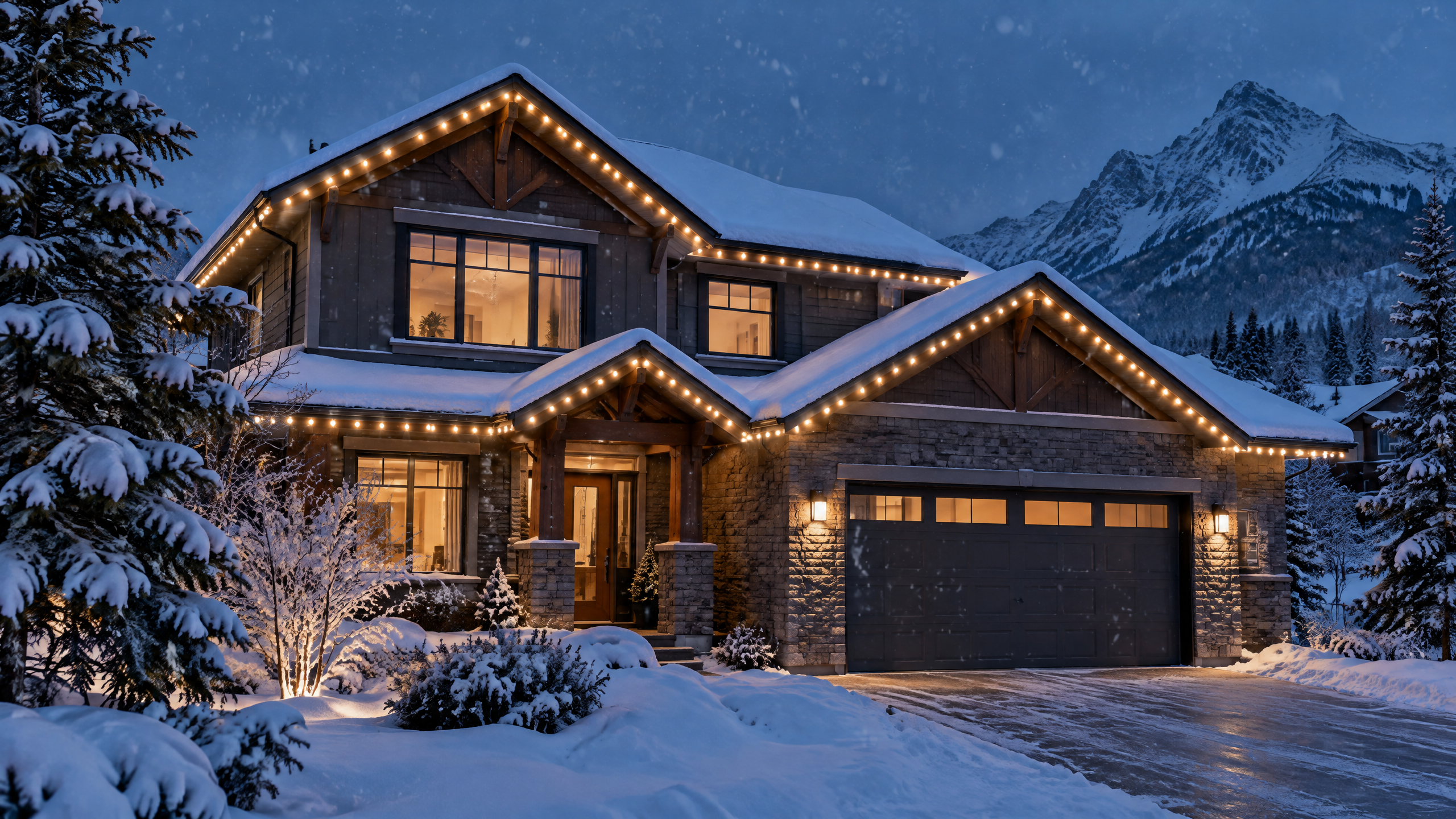
What does an Alberta winter actually do to a roofline?
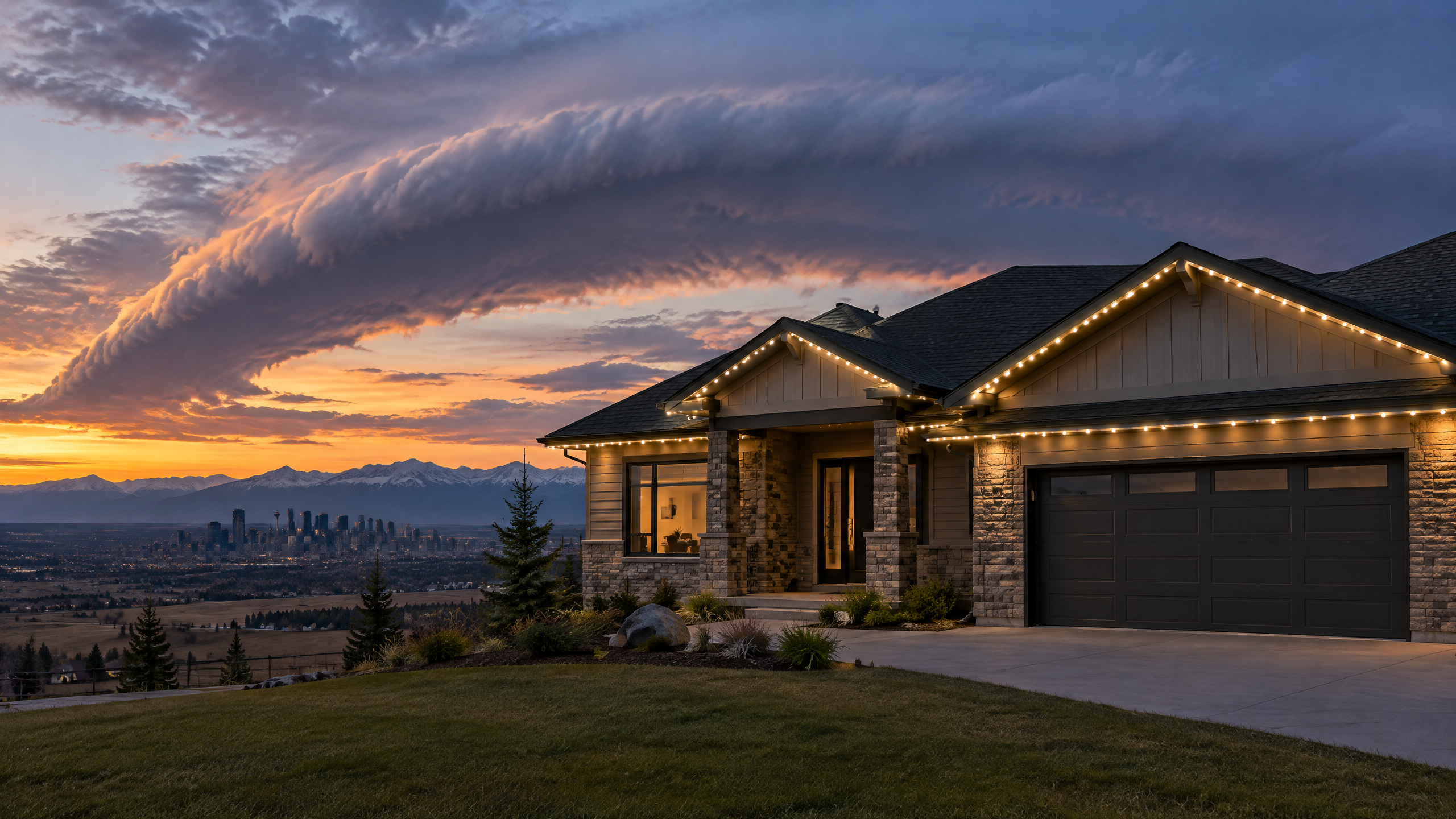
An Alberta roofline doesn't face one winter. It faces five different kinds of stress, often in the same week.
- Deep cold snaps. Cold snaps around Calgary can push toward −40°C. At that temperature, plastics turn brittle, wire jackets stiffen and any weak electronic part shows itself.
- Chinook swings. A Chinook can lift temperatures well above freezing within hours, then the cold returns. Every swing makes fascia, mounting and wiring expand and contract. Over a season, that adds up to a lot of freeze-thaw cycles.
- Snow and ice at the eave. Snow melts on the roof, runs to the eave and refreezes. The eave is exactly where ice dams and icicles form, and exactly where roofline lights live.
- Hail. The corridor from Calgary down to High River sees some of the worst hail in Canada. Summer storms hit anything mounted on the outside of a home.
- High-elevation sun. At over 1,000 metres, the UV is strong. Over years, UV yellows and weakens plastics that aren't built for it.
A permanent system has to handle all five, year after year, without coming down.
How to read a spec sheet: temperature range vs. IP rating
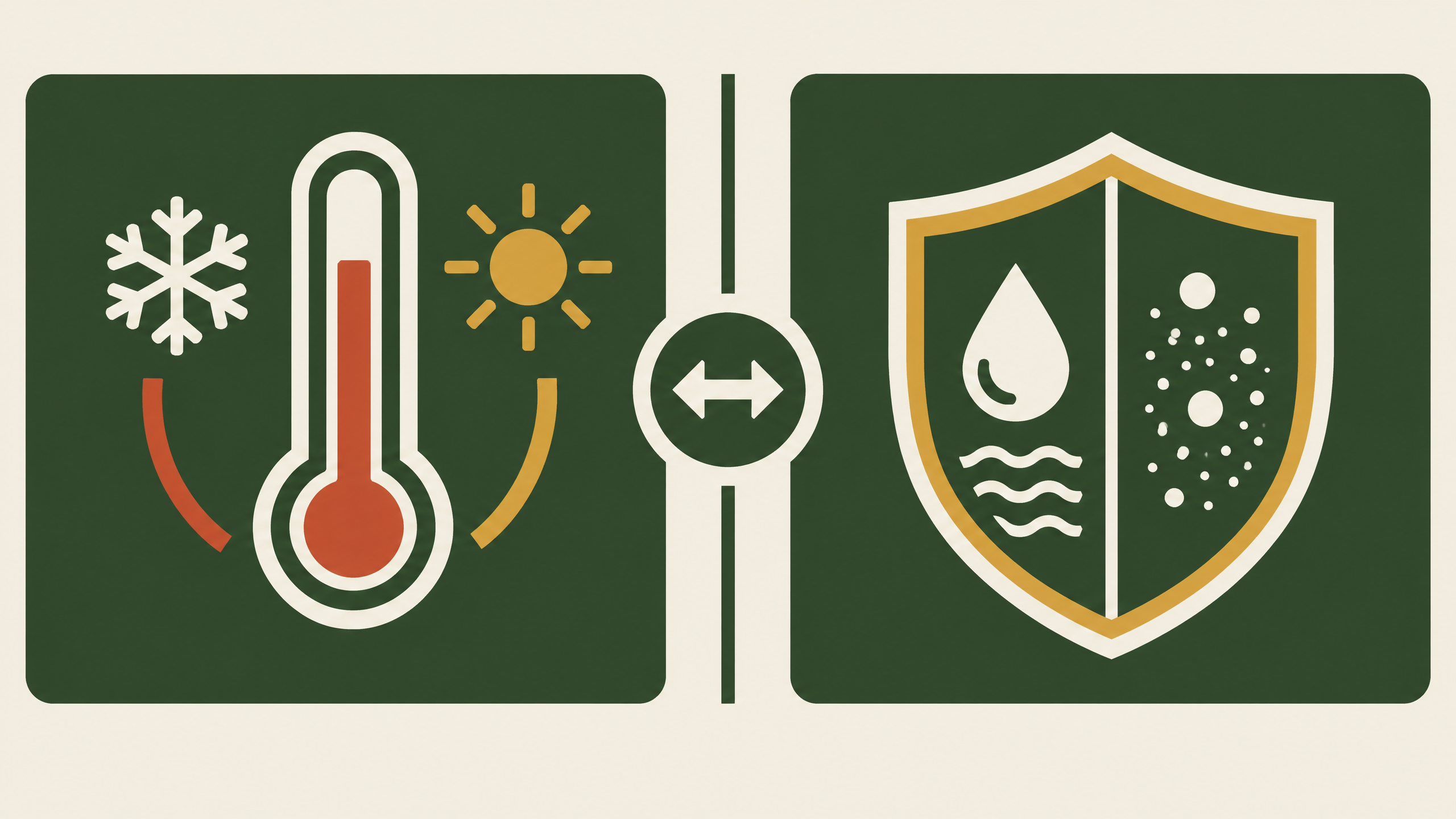
"Winter-rated" is a marketing phrase. A spec sheet is where the real answer lives. Any installer should be able to show you the spec sheet for the system they're quoting. Ask for it, and check these three things yourself.
Operating temperature range. This is the range the product is rated to run in. Look at the low end, and check it reaches the lows your area actually sees. Two traps: a storage temperature range is not an operating range, and the rating should cover the power supply and controller, not only the lights.
IP rating. IP stands for ingress protection. The first digit rates protection against dust; the second against water. IP65 means dust-tight and protected against water jets. IP67 covers temporary immersion, and IP68 covers continuous immersion under the maker's stated conditions. None of it says anything about cold. A light can be IP68 and still not be rated for an Alberta January.
Canadian certification marks. Electrical products sold for use in Canada should carry a recognized certification mark, such as CSA, cUL or cETL. Look for it on the product label, and especially on the power supply. A missing mark is a question worth asking before anything goes on your house.
Why mounting is a winter feature
Most people shop for the lights. In Alberta, the mounting matters just as much.
Adhesive tape and clips are the weak point in a freeze-thaw climate. Deep cold stiffens adhesive. Chinook meltwater runs behind tape and refreezes. Clips loosen as fascia expands and contracts. The common result is lights peeling, drooping or popping free by spring.
A mechanically fastened track is a different approach. It's fixed along the eave, colour-matched to the trim so it's discreet by day, and it doesn't rely on adhesive to stay put through a Chinook. For the full comparison, see our kit vs. professional install guide.
The parts people forget
The lights get the attention. These parts decide whether the system is still working in February.
- Controller and power supply placement. They need a protected spot, and a rating that matches where they sit. A power supply exposed to meltwater is a failure waiting for a thaw.
- Connections. Every join is a place water can get in and freeze. Sealed connections, and no more joins than the roofline needs, reduce the risk.
- Long runs. Power weakens over distance. A long run needs power fed at the right points so the far end matches the near end in brightness and colour.
- App connection. App control depends on the controller staying connected. Check that the controller's location has a reliable connection before the cold sets in.
How long do permanent lights last here?
LED lifespan is usually quoted in rated hours, often measured to the point where light output drops to 70 per cent. That number comes from lab testing. It's useful for comparing products, but it doesn't account for a −35° night followed by a +8° Chinook afternoon.
On an Alberta roofline, real lifespan depends on cold cycling, power supply quality, mounting and sealing. That's why a lifespan slogan matters less than the warranty behind the system. A warranty is someone promising, in writing, to stand behind the product and the work. Before you sign anything, see who stands behind your warranty.
Where Frontline stands
Here's what we put in writing:
- 10-year product warranty, backed by Magnificent Lighting (MAG), the manufacturer. The MAG system is installed on more than 6,000 homes.
- 7-year installation warranty on our work.
- Mechanically fastened, colour-matched track, custom-measured to your roofline. Our tracks are the #1 rated tracks in the industry.
- Single-home installs completed within 12 hours in most cases.
We install across the region, including permanent Christmas lights in Calgary, permanent Christmas lights in High River, permanent Christmas lights in Strathmore and permanent Christmas lights in Okotoks.
Can permanent lights be installed in winter?
Yes. We schedule installs year-round when weather and site conditions allow, and we confirm that at your consultation. Ice on the eaves, high wind and extreme cold days can move a date, because a safe install matters more than a fast one.
Planning ahead in High River? Read our High River guide to planning a permanent roofline.
The 7-point winter-ready checklist
Before you trust any permanent lighting system with an Alberta winter, check these seven things:
- Operating temperature rating. The low end of the operating range, not the storage range, reaches real Alberta lows, around −40°C.
- IP rating, read correctly. It tells you about water and dust protection only. It is not a cold rating.
- Canadian certification mark. A recognized mark, such as CSA, cUL or cETL, appears on the lights and the power supply.
- Mechanical mounting. The system is fastened along the eave, not held up by adhesive tape or clips.
- Protected power. The power supply and controller sit in a protected location and are rated for where they are installed.
- Sealed, planned runs. Connections are sealed, joins are kept to a minimum, and long runs are fed so brightness stays even.
- A two-part written warranty. It covers both the product and the installation, with a named company behind each.
Frequently asked questions
Do permanent lights work in Alberta winters?
Yes, when the system is built for it. The lights need an operating temperature rating that reaches real Alberta lows, mounting that's mechanically fastened rather than taped, and protected power and connections. Chinook freeze-thaw is harder on mounting than steady cold, which is why the track and installation matter as much as the LEDs.
What temperature rating should permanent lights have for Alberta?
Look for an operating temperature range whose low end reaches at least −40°C, since cold snaps around Calgary can approach that. Check that it's the operating range, not the storage range, and that it applies to the power supply and controller as well as the lights. If a quote can't show you the number, ask for the spec sheet.
Does an IP65/IP68 rating tell you a light survives cold?
No. An IP rating measures ingress protection: the first digit is dust, the second is water. IP65 means dust-tight and protected against water jets; IP68 means protected against continuous immersion under the maker's stated conditions. Neither says anything about cold. For that, check the operating temperature range separately.
What does Chinook freeze-thaw do to lights and mounting?
A Chinook can lift temperatures above freezing in hours, then the cold returns. Each swing makes the fascia, mounting and wiring expand and contract, and meltwater can run into gaps and refreeze. Over a winter that's many cycles. Adhesive and clips loosen first; a mechanically fastened track and sealed connections are built to handle it.
Can hail damage permanent roofline lights?
It can. The Calgary to High River corridor sees some of Canada's worst hail, and anything on the outside of a home is exposed. Lights mounted along the eave are less exposed than the roof surface, but not immune. After a major storm, check the run, and ask how hail damage is handled under warranty or home insurance.
How long do permanent lights last here?
LED lifespan is usually quoted in rated hours, often as the point where light output falls to 70 per cent. That figure comes from lab conditions. On an Alberta roofline, real lifespan depends on cold cycling, power supply quality, mounting and sealing. The warranty behind the system tells you more than any lifespan slogan.
Do I take them down, cover them or turn them off in a storm?
No to all three for a permanent system. It's designed to stay up year-round, so there's nothing to take down or cover, and covering it can trap moisture. You can leave it running or switch it off in the app; that's your choice. After a major storm, look the run over for damage.
Can permanent lights be installed in winter?
Yes. Frontline schedules installs year-round when weather and site conditions allow, and we confirm that at your consultation. Ice on the eaves, high wind and extreme cold days can move a date. Single-home installs are completed within 12 hours in most cases.
What should I check on any quote or spec sheet before believing "winter-rated"?
Check five things: the operating temperature range and its low end, the IP rating read as water and dust protection only, a Canadian certification mark on the lights and power supply, how the system is mounted, and a written warranty covering both product and installation. "Winter-rated" without those details is a slogan.
Want to know how your roofline will handle this winter?
Book a free in-home consultation. We'll look at your eaves, walk you through the spec, and give you an itemized quote with the warranty in writing. Call (825) 395-4002.